


Artificial intelligence is no longer just about automation or content generation. Enterprises across the United States are now exploring systems that can think, plan, and act with minimal human intervention. That is exactly where agentic AI solutions enter the picture.
If you are trying to understand how this technology works and why it matters for your business, this guide will break it down clearly. We will explore the benefits, the architecture behind these systems, and real world use cases that show measurable impact.
What Are Agentic AI Solutions
At a practical level, agentic AI services & solutions are autonomous systems designed to achieve goals rather than simply respond to instructions. Traditional AI waits for prompts. Agentic systems proactively identify tasks, make decisions, and execute actions across integrated platforms.
For example, instead of generating a sales report when asked, an agentic system can analyze performance trends, detect declining conversion rates, adjust campaign targeting, and notify stakeholders automatically. That shift from reactive to proactive intelligence is what makes this approach transformational.
The Business Case for Agentic AI
Enterprises are dealing with increased operational complexity. According to industry research, over 70 percent of large organizations report workflow inefficiencies caused by siloed systems and manual coordination.
Agentic AI solutions for enterprises address this by connecting data, decision logic, and execution into one unified framework. When workflows become autonomous, teams gain speed, accuracy, and scalability.
For you, this means fewer bottlenecks and more time spent on strategic initiatives instead of repetitive tasks.
Core Benefits of Agentic AI Solutions
One major advantage is intelligent automation. Unlike rule based systems, agentic AI adapts to changing inputs and learns from outcomes.
Another benefit is improved decision quality. These systems analyze multiple variables simultaneously, often identifying patterns humans might overlook.
Cost efficiency is also significant. Enterprises implementing advanced AI driven workflows have reported operational cost reductions between 15 and 30 percent within the first year.
Most importantly, agentic AI improves agility. In competitive US markets, the ability to adapt quickly can define long term success.
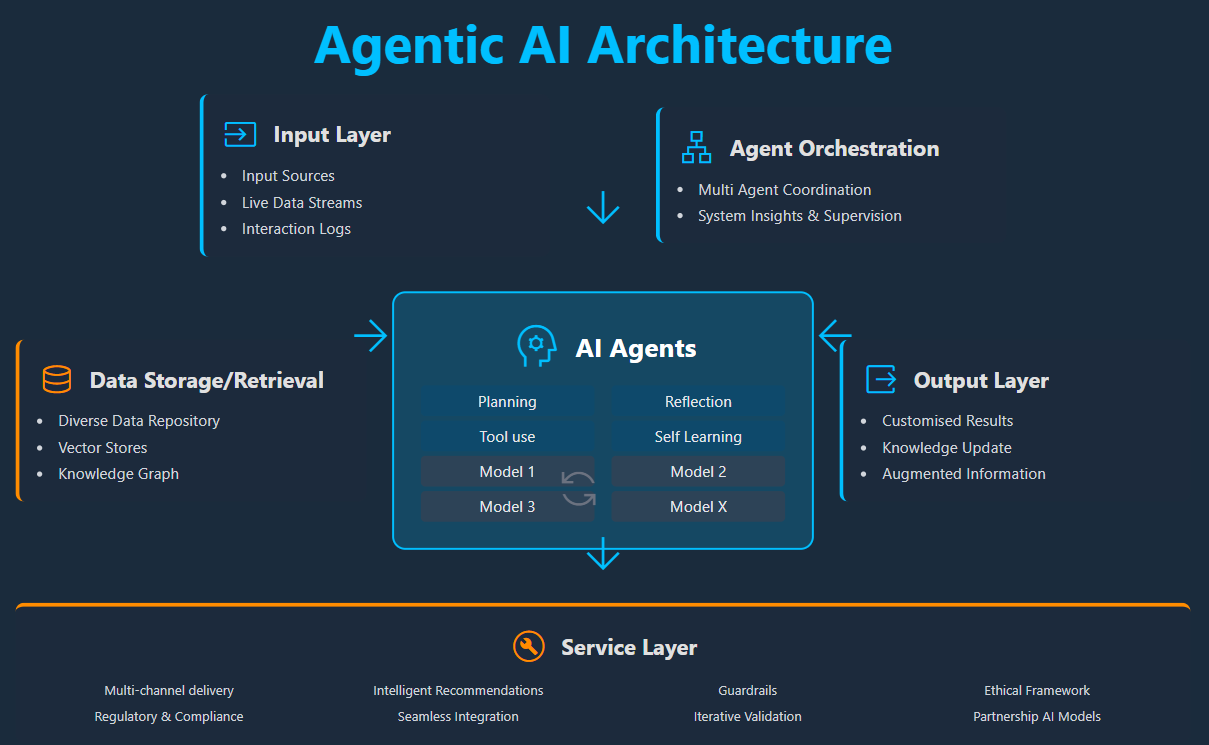
Understanding the Architecture
To fully grasp how this works, you need to understand the technical foundation behind agentic AI data solutions.
The first layer is data ingestion. The system collects structured and unstructured data from CRM systems, cloud platforms, internal databases, and external sources.
The second layer is reasoning and context modeling. This engine interprets data, sets goals, and determines optimal strategies.
The third layer is planning and task decomposition. Here, the AI breaks down complex objectives into manageable steps.
The fourth layer is execution. Through APIs and system integrations, the agent performs actions such as updating dashboards, sending communications, or adjusting operational parameters.
Finally, the feedback loop ensures continuous improvement by analyzing performance results and refining future actions.
How Agentic AI Differs From Generative AI
Many executives confuse agentic AI with generative AI. Generative systems create content such as text, images, or code. Agentic systems use generation as one capability within a larger autonomous framework.
Generative AI writes a marketing email. Agentic AI analyzes customer behavior, decides who should receive the email, customizes the message, schedules delivery, tracks engagement, and optimizes follow up campaigns.
That broader orchestration makes it more suitable for enterprise level transformation.
Real World Use Cases in Enterprises
In supply chain management, agentic systems predict demand fluctuations and adjust procurement strategies automatically. Some companies have reduced stockouts by nearly 25 percent after adopting intelligent automation.
In finance, AI agents monitor transactions, detect anomalies, and initiate compliance workflows in real time.
In human resources, autonomous systems analyze workforce data, identify skill gaps, and recommend training programs aligned with strategic objectives.
Across these examples, agentic AI solutions move beyond insight generation to direct action.
The Role of Data Governance
Successful deployment depends on strong data governance. Without reliable data, even the most advanced system cannot perform effectively.
Enterprises that invest in structured data pipelines and governance frameworks are nearly twice as likely to achieve measurable AI ROI.
If you are planning adoption, start by assessing your data maturity before scaling automation efforts.
Implementation Strategy for Modern Businesses
Adopting agentic AI services & solutions requires a phased approach. Begin with a high impact workflow that is repetitive and measurable. Define KPIs clearly.
Next, integrate the AI system with your existing platforms. Monitor performance closely and refine the model based on feedback.
Gradually expand into additional departments once results are validated. This reduces risk and builds internal confidence.
Addressing Common Challenges
One challenge is change management. Employees may fear automation replacing their roles. In reality, agentic AI enhances human productivity rather than eliminating it. Teams focus on strategy while AI handles operational complexity.
Another challenge is system integration. Ensuring compatibility between AI frameworks and legacy systems requires careful planning.
With the right roadmap, these challenges become manageable.
Measuring ROI and Long Term Impact
Return on investment should be measured across multiple dimensions including cost reduction, productivity improvement, speed to market, and revenue growth.
Some US enterprises have reported 20 percent faster product launches and 18 percent higher customer retention rates after implementing autonomous AI workflows.
When aligned with business objectives, agentic AI solutions for enterprises create sustainable competitive advantage.
The Future Outlook
As AI models become more advanced and integration capabilities expand, agentic systems will handle increasingly complex tasks. Experts predict that within five years, a majority of enterprise workflows will include some level of autonomous decision making.
For your organization, early adoption provides an opportunity to build expertise before competitors catch up.
Conclusion
Agentic AI solutions combine intelligent automation, adaptive reasoning, and seamless system integration to transform enterprise operations. By understanding the architecture, benefits, and real world applications, you can move beyond experimentation and into strategic implementation.
If your goal is to drive efficiency, innovation, and scalable growth, investing in agentic AI data solutions today positions your organization for long term success in an increasingly competitive landscape.
